GTM Territory Planning & Account Development System
A structured Account Executive workflow for turning market research into targeted pipeline.
This portfolio piece outlines my process for building pipeline in complex B2B markets: research the market, define the ICP, build the account universe, map stakeholders, execute multichannel outreach, learn from live conversations, update CRM, and prioritize the territory.
Within 30 days of launching the campaign, a conversation with a regional buyer revealed that corporate procurement controlled approximately $160M of category spend across all divisions. That discovery led to a meeting with corporate procurement and shifted the GTM strategy from regional buyer outreach to enterprise stakeholder mapping, expanding the account plan toward category-level budget owners and higher-value decision-makers.
The purpose of this workflow is to replace random prospecting with a structured, research-backed territory system that improves as live market feedback comes in.
Prospecting is treated as a volume problem.
Complex B2B sales teams often treat prospecting as a volume problem: more calls, more emails, more LinkedIn touches. Activity matters, but activity without market structure creates weak pipeline. The deeper problem is usually upstream:
A structured account development process.
The process moves from market ambiguity to structured pipeline development through seven steps — with live market feedback reshaping the account map along the way.
Market Research
The process starts with research before outreach. The purpose is to understand market structure, players, competitors, buyer personas, use cases, pricing, and timing — the foundation for targeted account development instead of generic cold prospecting.
- Industry reports from research organizations
- Trade groups and trade networks
- Competitor blogs, product pages, and case studies
- Pricing pages and public product materials
- Customer lists and testimonials
- Search engines and company websites
- Event and exhibitor directories
- Prospect conversations and referrals
ICP Development
I define the ideal customer profile based on the product, buyer environment, and likelihood of conversion. The ICP becomes searchable criteria for building the account universe across Sales Navigator, search engines, enrichment platforms, and trade directories.
- Use case and buyer pain
- Company size and geography
- Budget ownership and urgency
- Operating need and adoption likelihood
- Strategic fit
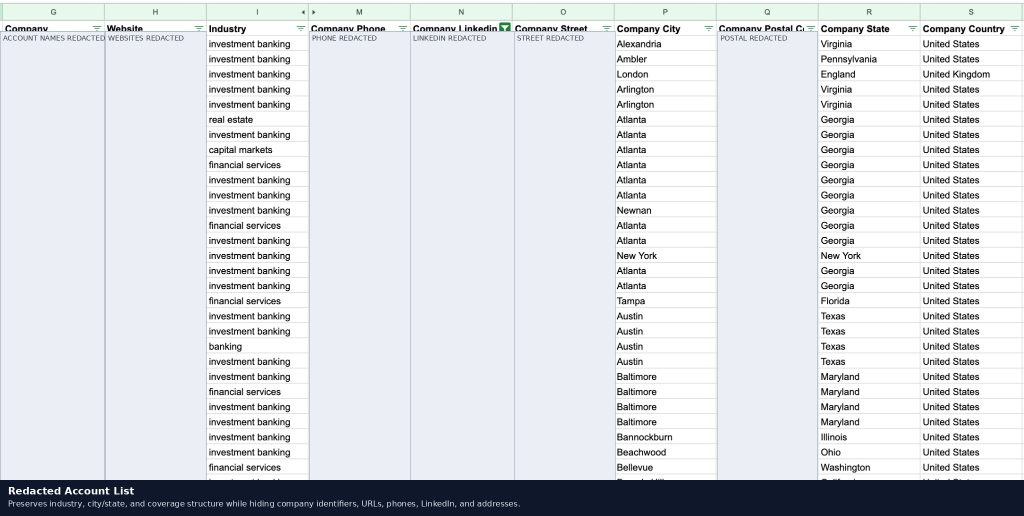
Account List Construction
Once the ICP is defined, I build the account universe — both direct-fit and lookalike accounts — then segment by fit, geography, opportunity size, buying complexity, and priority tier.
- Direct-fit accounts and lookalike accounts
- Competitor customers
- Trade association members
- Event attendee and exhibitor lists
- Regional operators
- Parent companies and subsidiaries
- Referral-sourced accounts
Stakeholder Mapping
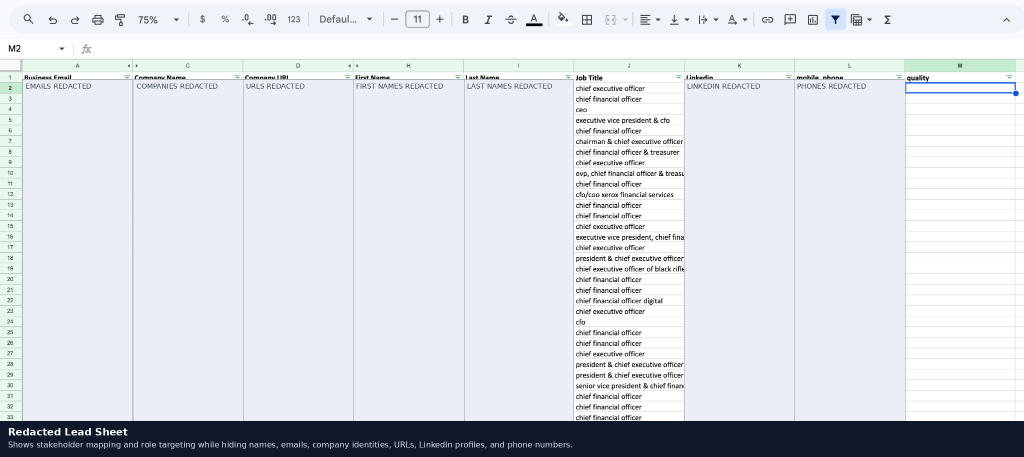
After building the account universe, I map the likely buying participants. The goal is to understand not just who works at the company, but who is likely to influence or control the buying decision.
- Economic buyers and corporate procurement
- Regional buyers, department heads, and operators
- Finance leaders and technical evaluators
- End users, executive sponsors, influencers, and referral sources
- Tools: LinkedIn Sales Navigator, Apollo, ZoomInfo, ListKit, Prospeo, search engines, company websites, CRM records
Multichannel Outreach
Once the account and stakeholder map is built, I run outreach across multiple channels. Outreach is not only for pitching — it is also for learning the market. Every conversation is treated as a market intelligence event.
- Email, LinkedIn, phone, and SMS
- Referrals and general company contacts
- Field visits where relevant
- Discovery questions that refine the account map: who owns the category, who controls budget, where purchasing sits, and who else should be involved
Expanding From Regional Buyer to Corporate Spend Owner
During outbound discovery, I spoke with a regional buyer who helped clarify how purchasing authority was structured across the account. The initial account view suggested that regional buyers were the primary stakeholders.
However, the conversation revealed that corporate buyers controlled approximately $160M of spend across all divisions for a specific product category within the portfolio's capabilities. That insight changed the GTM strategy.
Instead of only pursuing regional stakeholders, the account plan expanded to include corporate category buyers, procurement leadership, and additional division-level contacts tied to the same spend category.
This is why live prospecting matters. A good outbound motion does not only generate meetings — it improves the account map, identifies larger budget owners, surfaces internal buying structure, and reveals better paths into enterprise-level opportunities.
Commercial takeaway: One live discovery conversation can turn a regional account strategy into a broader enterprise stakeholder map.
CRM and Forecasting
All account, stakeholder, activity, and qualification data gets uploaded into CRM for review. The CRM is not just a recordkeeping system — it becomes the operating layer for territory development, forecasting, pipeline coverage, and next-best actions.
- CRM systems: Salesforce, HubSpot, Excel, or Google Sheets
- Account segment, ICP fit, and stakeholder role
- Outreach status, conversation notes, and pain point
- Budget ownership, buying process, and timing
- Opportunity size, forecast category, next step, follow-up date, and pipeline stage
Field Sales Mapping
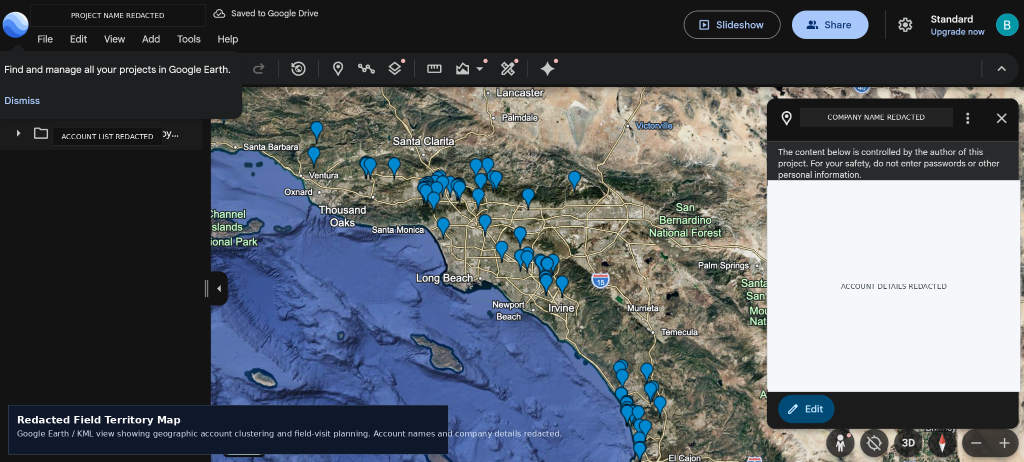
For field roles, account locations can be mapped to improve territory coverage. LLM-assisted planning then creates optimized itineraries that maximize high-value account coverage while reducing wasted travel time.
- Google Earth, KML files, Google Maps, and CRM exports
- LLM-assisted itinerary planning
- Identify geographic account clusters
- Plan in-person visits and optimize route efficiency
- Support regional prospecting days, meetings, and marketing events
A practical GTM stack.
Practical ability across the GTM motion.
A strong account executive builds the list.
A strong account executive does not just work a list. They build the list, understand the market, identify the right stakeholders, test messaging, learn from live conversations, update the territory map, track the pipeline, and focus time where the probability of revenue is highest.
This workflow demonstrates how I move from market ambiguity to structured pipeline development.
Selected account names, contact details, pipeline notes, and company-specific commercial information have been redacted or generalized. This case study is for portfolio demonstration purposes only.